A healthcare waiting room takes more daily traffic than almost any other room in the building. Here's what practice administrators should actually specify — before style ever enters the conversation.
Patients form an opinion about a practice before a clinician ever walks in the room. The waiting room does that work — and it does it under conditions most other commercial spaces never see: dozens of different bodies sitting down and standing up every day, spills and hand sanitizer and worse, and a facilities budget that has to make the furniture last years, not seasons.
Most practices start the conversation with fabric color and chair style. Those decisions matter, but they come after four questions that actually determine whether the furniture holds up and does its job.
How Many Seats, and What Kind, Does the Room Actually Need?
Seat count is not just square footage divided by chair width. A waiting room needs a mix:
- Standard guest chairs for the majority of visitors
- Companion and family seating grouped so people arriving together can sit together
- ADA-compliant clearances distributed through the room, not clustered in one corner
- Bariatric-rated seating — extra-wide, higher weight capacity — specified alongside standard chairs so no visitor is stuck standing or asking for an alternative
Practices that specify one uniform chair for the whole room usually end up retrofitting bariatric or accessible seating later, at a higher cost and with a mismatched look. Planning the mix up front avoids that.
Fabric and Frame: Cleanable First, Comfortable Second
A waiting room chair gets cleaned far more often than an office chair — sometimes multiple times a day, with disinfectants stronger than what a typical fabric is rated for. Before comfort or color, confirm:
- The fabric is rated for the specific disinfectants your practice actually uses (quaternary ammonium compounds and bleach-based products are common, and not every fabric tolerates both)
- Seams are sealed or minimized — exposed stitching is where contamination collects and where fabric fails first
- Frames are metal or hardwood, not particleboard, at any contact point that takes repeated weight and cleaning
- Casters or glides are appropriate for your actual flooring, not a default spec
Manufacturers like KI and Global Furniture Group publish cleanability and BIFMA durability ratings for their healthcare-grade lines — ask for that documentation before finalizing a fabric, not after a chair fails.
Gang and Beam Seating Belongs in High-Traffic Rooms
Individual lounge chairs look more residential, but a waiting room that turns over dozens of visitors an hour usually needs at least some gang or beam-mounted seating — chairs connected on a shared frame. It keeps rows straight without constant rearranging, distributes weight and wear more evenly than freestanding chairs, and holds up to years of public use in a way loose furniture generally doesn't. The right ratio of gang seating to individual lounge chairs depends on your actual patient volume, not a fixed formula — a two-provider practice and a hospital-affiliated imaging center should not be furnished identically.
Sightlines to the Front Desk
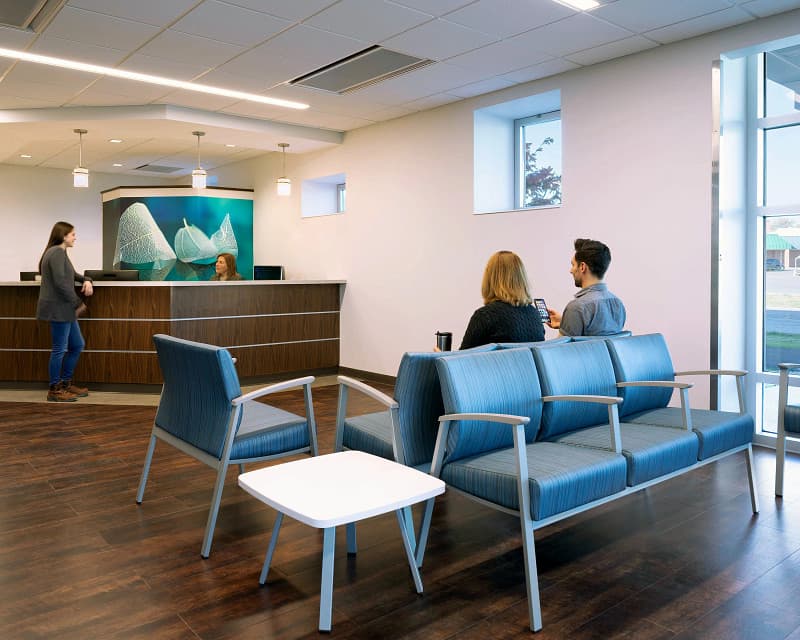
Furniture layout affects how staff can actually run the room. Reception and check-in staff need a clear sightline across the waiting area — to call names, watch for anyone who needs help, and keep an eye on the room without leaving the desk. Coffee tables, planters, and tall-backed lounge furniture placed without a layout plan can block that sightline just as easily as a poorly placed wall. This is a space-planning problem before it's a furniture-selection problem: the layout should get drawn before the chairs get chosen.
Purchasing: What Actually Applies to a Healthcare Practice
Larger healthcare systems often have access to GPO pricing through Vizient or Premier; independent practices and smaller groups typically do not, and buy directly instead. In Florida, government-affiliated healthcare facilities can also purchase through the FL State Contract where it applies. None of these paths are required — they're worth checking before assuming a project has to go through a full competitive process.
Getting the Layout Right Before You Order
The furniture decisions above only work if the room layout is planned around your actual visitor volume and traffic pattern, not just the square footage on a floor plan. Brixner Office Furniture provides free space planning and product specification for waiting room furniture in healthcare practices, government offices, and professional businesses throughout Florida and nationwide — including the seating mix, fabric specification, and layout that keep a high-traffic waiting room running the way your staff actually needs it to. Contact us to start planning yours.